
The Assumptions Hurting Nonprofit Organizations the Most Right Now

Updated: May 11

A Business Strategy Argument for Mission Driven Organizations
Tamika Curry, Ph.D., Founder and CEO, Morse Regent
Picture the earliest nonprofit organizations in this country. The hospitals founded by religious communities to care for the sick. The community organizations built in neighborhoods where no other services existed. The churches that fed people, housed people, and educated children long before any government program existed to do it. These organizations were built on a simple and powerful premise. There is a need. We will meet it. The model was equally simple. You provided a program or a service and you got paid for what you provided. Program funding. Service delivery. That was the financial engine and for a long time it worked.
We do not live in that world anymore. And while program funded contracts still exist, the funding landscape has fundamentally shifted. Government reimbursement rates have not kept pace with the actual cost of delivering services. Federal and state funding streams that organizations built entire programs around are being reduced, restructured, or eliminated. And yet many nonprofit organizations are still operating under the same set of assumptions that governed the sector thirty years ago. Those assumptions show up in how we talk about what nonprofit actually means. They show up in how we think about compensating the people who lead these organizations. And they show up in how organizations decide what programs and services to offer and which ones to let go. Each of these is a symptom of the same root problem. A belief, often unspoken, that operating with business discipline is somehow at odds with having a mission. It is not. And that belief is costing organizations their future.
The only legal difference between a nonprofit and a for-profit is the tax status. Everything else about what it takes to build and sustain a healthy organization is identical.
The Conversation About Tax Status We Keep Avoiding
Let me start with the most fundamental assumption. The word nonprofit describes your tax structure. It describes how the IRS classifies your organization and how your surplus revenue must be reinvested. It does not describe how you should think about revenue generation, operational efficiency, or strategic focus. Those things work the same way whether you are a 501c3 or a for-profit corporation. The organizations navigating this funding environment well are the ones that have fully internalized that. They run their organizations like businesses because they are businesses, mission driven ones, but businesses nonetheless.
Once you accept that, a second conversation becomes unavoidable. If we are running businesses, then the people leading those businesses deserve to be compensated accordingly. The idea that a leader managing a multimillion dollar organization with thousands of employees, multiple funding streams, a board of directors, and complex regulatory requirements should accept below-market compensation because the organization has a charitable mission is an outdated and harmful concept. We have all seen the reaction when a pastor of a thriving mega church drives a nice car. The congregation is shocked. But that church may have annual revenue in the tens of millions, dozens of staff, multiple departments, and significant operational complexity. Why would we expect the person leading that organization to be paid as if it were a small side project? The same logic applies to nonprofit executives. Under compensating leaders does not honor the mission. It drives talented people out of the sector at exactly the moment we need them most.
But the same mindset that accepts under compensation also accepts another equally costly pattern. The belief that saying yes to every program, every contract, and every community need is what mission commitment looks like. I hear versions of this in nearly every conversation I have with nonprofit leaders right now. Letting go of a program feels like abandoning the people it serves. I understand this because I have felt it too. Narrowing focus feels like shrinking the mission. And so organizations hold on.
They spread already thin resources even thinner. They ask exhausted staff to do more with less. And they call it commitment while the financial indicators tell a different story.
Dominate What You Do Well. Divest What You Do Not.
The organizations finding their financial footing right now are not the ones doing the most. They are the ones doing the right things exceptionally well. They identified the programs and populations where they have genuine clinical or operational strength, where their outcomes are documented, where their referral relationships run deep, and where their reputation is unmatched in their market. And they made the hard decision to build their identity and their revenue model around that. The programs they were not excelling in, the contracts they were carrying at a loss, the service lines added out of opportunity rather than strength, those are going away.
The healthcare sector is showing us exactly what this looks like in practice. Earlier this year the Healthcare Financial Management Association reported that rural hospitals saw their overall finances begin to improve in 2025, with median operating margins trending in the right direction after years of decline. One of the key drivers was strategic conversion to critical access hospital status, a deliberate trade that limits inpatient bed capacity in exchange for higher Medicare reimbursement rates and a more sustainable operating model. Forty-five hospitals made that conversion over the past three years. That is not a retreat. That is a strategic decision to do fewer things at a higher level of financial sustainability. The same principle applies directly to nonprofit service organizations. Doing fewer things exceptionally well is not a compromise of the mission. It is what protecting it actually looks like.
An organization that tries to do everything with insufficient resources does not serve anyone at the level they deserve.
Diversify Revenue Around Your Strength, Not Away From It.
Once an organization has that clarity about what it does exceptionally well, the revenue diversification conversation changes entirely. Medicaid cannot be the only funder. That is not a strategic opinion at this point. It is a structural reality the current federal funding environment is making impossible to ignore. But diversifying revenue is not the same as chasing every available funding opportunity regardless of fit. The providers doing this successfully are building outward from their core strength. The behavioral health organization with deep clinical credibility in a specific school community builds school partnerships because they are already trusted there. They do not chase a contract in a geography or a population they have never served. They go deeper into what they already do exceptionally well and let that reputation open doors that contracts alone never could.
The sequence matters and it is the part most organizations get backward. Establish your strength first. Build the depth that makes you the obvious choice in your category. Then let that foundation support the revenue diversification that creates long-term stability. Organizations that try to diversify before establishing that core strength end up spread thin in two directions at once. That is not a growth strategy. That is a faster path to the same crisis.
The organizations navigating this moment well are not waiting for the funding environment to improve before they make decisions. They have accepted that nonprofit is a tax status and nothing more. They are paying their leaders what the work is worth. They are honest about where they excel and where they do not. And they are building revenue models that reflect the current reality rather than the one that existed twenty years ago. None of that is a departure from the mission. It is what honoring the mission looks like in 2026.
Know what you do well. Do it better than anyone else. Build your revenue around that. Let the rest go.
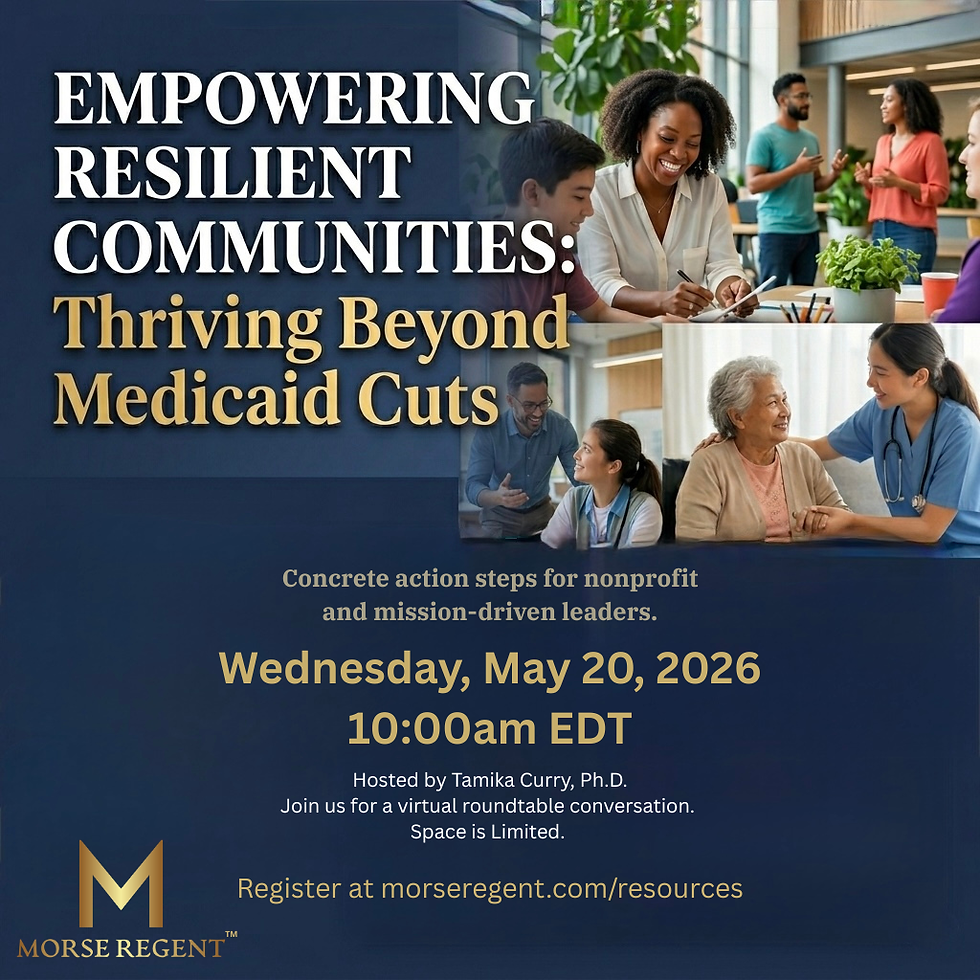
If you are a nonprofit or mission driven leader navigating these exact challenges right now, I want to invite you to our upcoming webinar, Empowering Resilient Communities: Thriving Beyond Medicaid Cuts, a virtual roundtable conversation. Space is limited. Register: morseregent.com/resources
Morse Regent is a turnaround advisory and interim executive leadership consulting firm partnering with mission-driven organizations, particularly those in healthcare, behavioral health, and education, at pivotal inflection points in their financial and operational performance, so that the organizations doing the most important work in our communities can continue to make the impact they were built to deliver. If any part of this resonated with you, let's talk.